
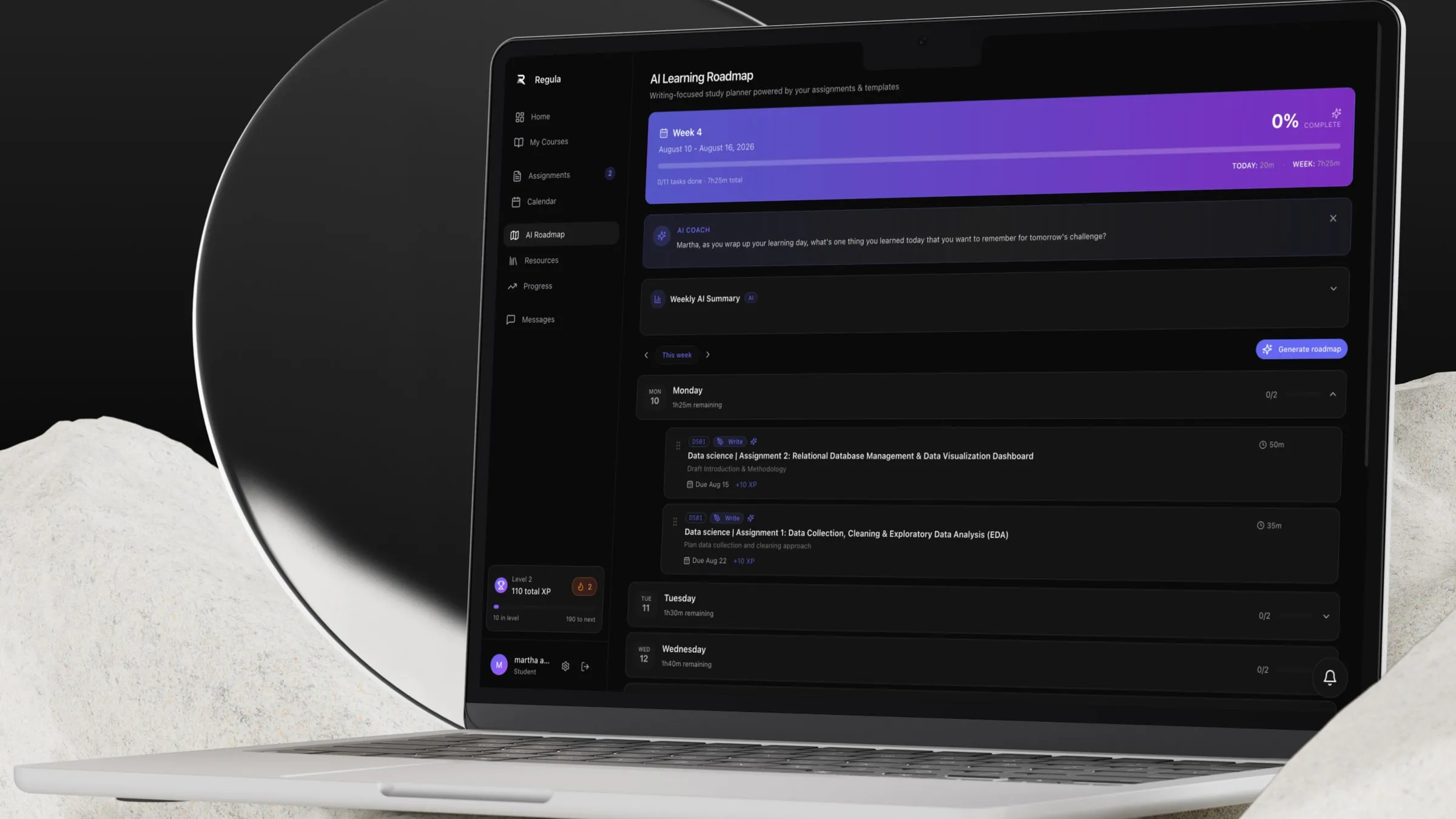
Regula
An AI-enhanced learning platform that Nikodem Płocki and I designed and built, and that I then studied with 54 students.
Overview
The problem
Students usually know what they should be studying. Where it breaks is turning “I should study” into tasks small enough to start, and noticing afterwards whether any of it happened.
What I did
Nikodem Płocki and I designed and built Regula, a learning platform where the AI is held to three narrow jobs. I led the research: a two-week study with 54 students across two waves, using system logs, validated questionnaires and 20 interviews.
What changed
With AI planning support, students created three times as many tasks, but they didn’t finish a larger share of them. Interviews described deeper reflection. The validated questionnaires registered none of it.
Process
- 01
Frame
Self-regulated learning research, and Design Science Research as the method.
- 02
Early test
November 202546 students used an early version at the S.T.A.R.S. hackathon at LUT University, Finland.
- 03
Design and build
Flows for both study conditions, wireframes and interface. Built on Lovable, with AI limited to three features.
- 04
Study
April and June 2026Two waves, two weeks each. 54 enrolled, 33 active. System logs, the MAI and MSLQ questionnaires, and 20 interviews.
- 05
Analyse and report
Non-parametric tests in R. Both authors checked every interview quote against its code. A master’s thesis, then a paper for PERSUASIVE 2027.
Understand
Research on self-regulated learning describes a cycle: plan the work, keep track of it while you do it, then reflect on how it went. Students tend to plan loosely and keep track almost never. Reflection mostly happens when something forces it.
A language model can take over nearly any part of that cycle, and that was the risk. If it plans the work and does the work, there’s nothing left for the student to regulate. So our question got narrower: which parts can AI carry without taking away the parts that matter?
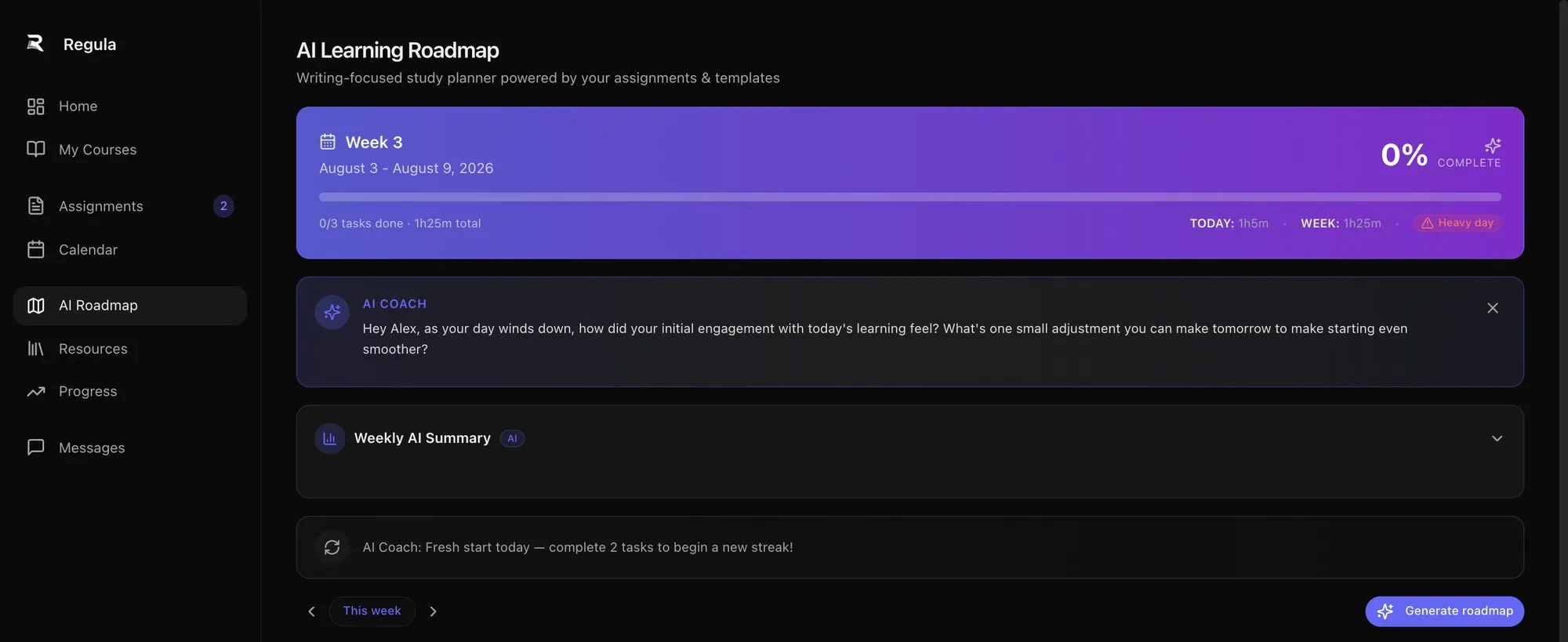
The AI Learning Roadmap: a week of study, broken into tasks small enough to start.
Define
Regula’s AI does three things. It breaks an assignment into daily tasks, comments on submitted work and finds material to read. It never does the work, and it never decides for you.
We settled that in the first week. An assistant that plans for you and studies for you leaves no self-regulation to support, and what you’ve built is a very expensive to-do list.
Scoping it this tightly meant accepting a risk. Planning would get easy, and follow-through might not. That’s what happened. I’d make the same call again, and this time I’d design for that gap from the start.
It also made the study possible. The Controlled version is the same product with those three features removed, so a difference between the groups points at a feature rather than at “AI” in general.
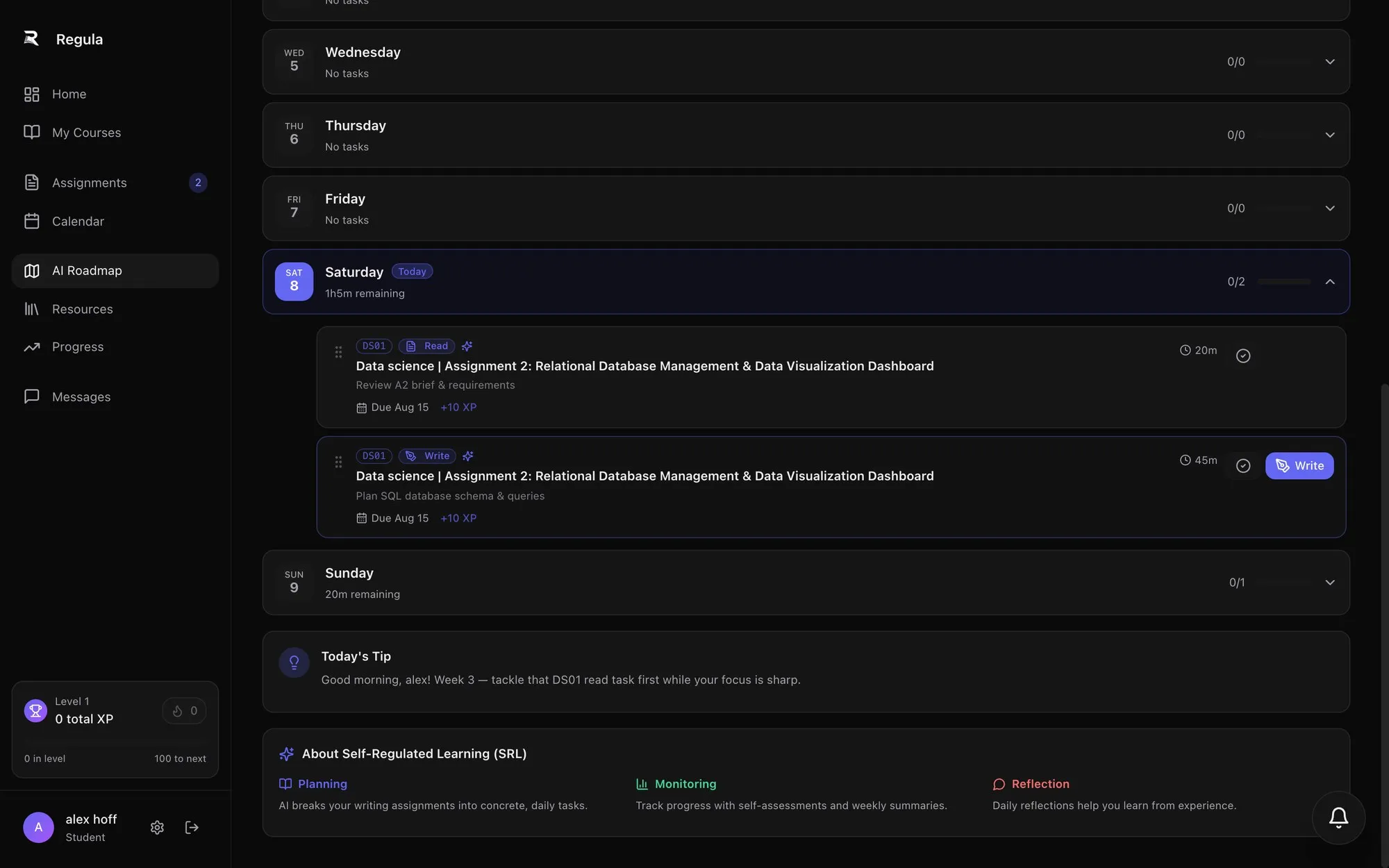
AI Roadmap
Turns an assignment into a week of daily tasks, each with a duration and a due date. This is the feature that moved the numbers.
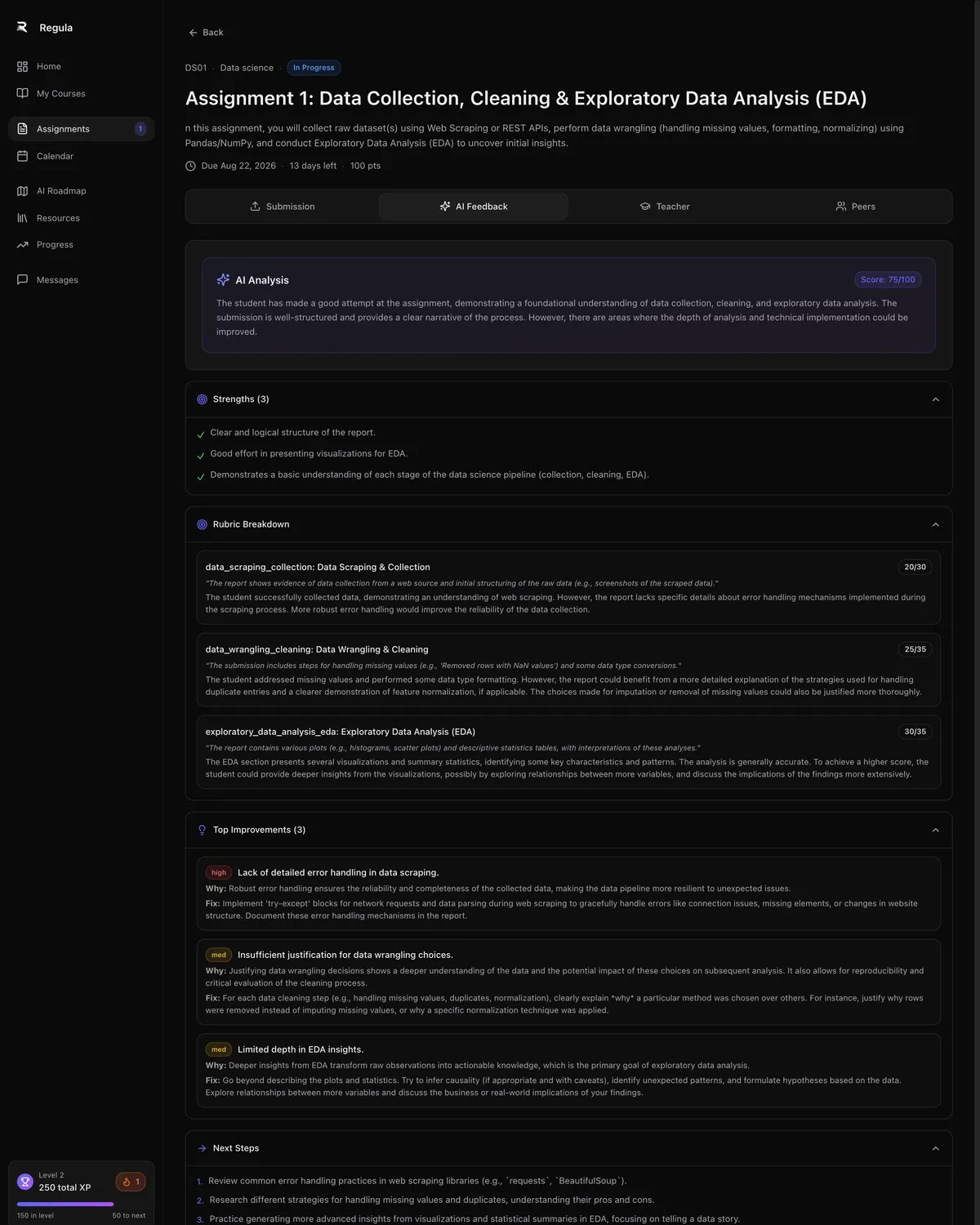
AI Feedback
Rubric-aligned feedback on a submitted draft, with a score, strengths and fixes. It’s marked as preliminary and always points back to the instructor.
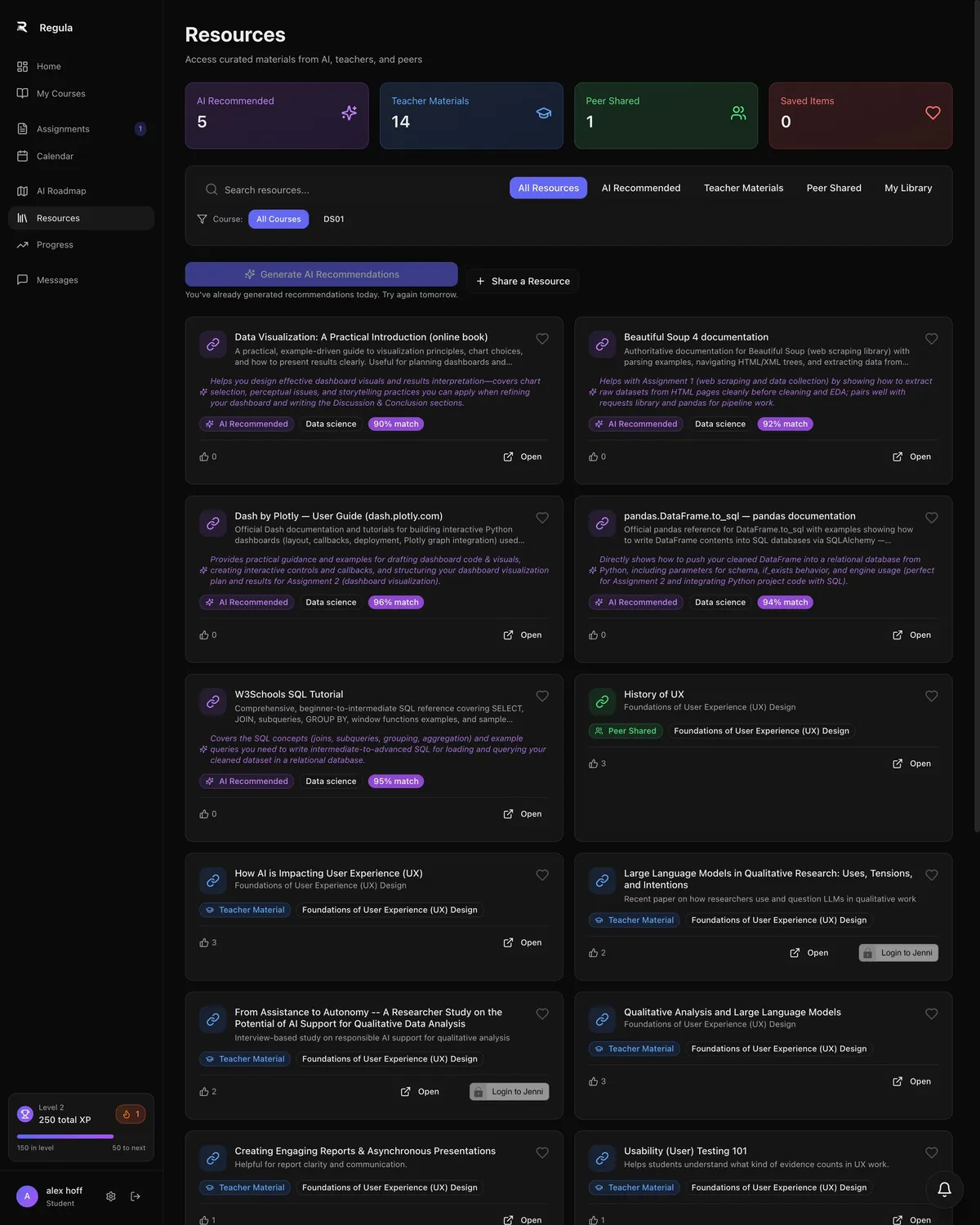
AI Resources
Recommendations sit next to teacher materials and peer-shared items, labelled, so the source of a suggestion is never in doubt.
Design
Two versions of one product. In the Controlled version students plan by hand and none of the three AI features appear. Tasks, XP, streaks, the leaderboard and the reflection prompts work the same in both.
Drag sideways to follow the flow.
Open full sizeThe AI Roadmap breaks the assignment into daily tasks. From there, writing and reading tasks, XP and the daily and weekly reflections run the same in both versions.
The same week in both versions
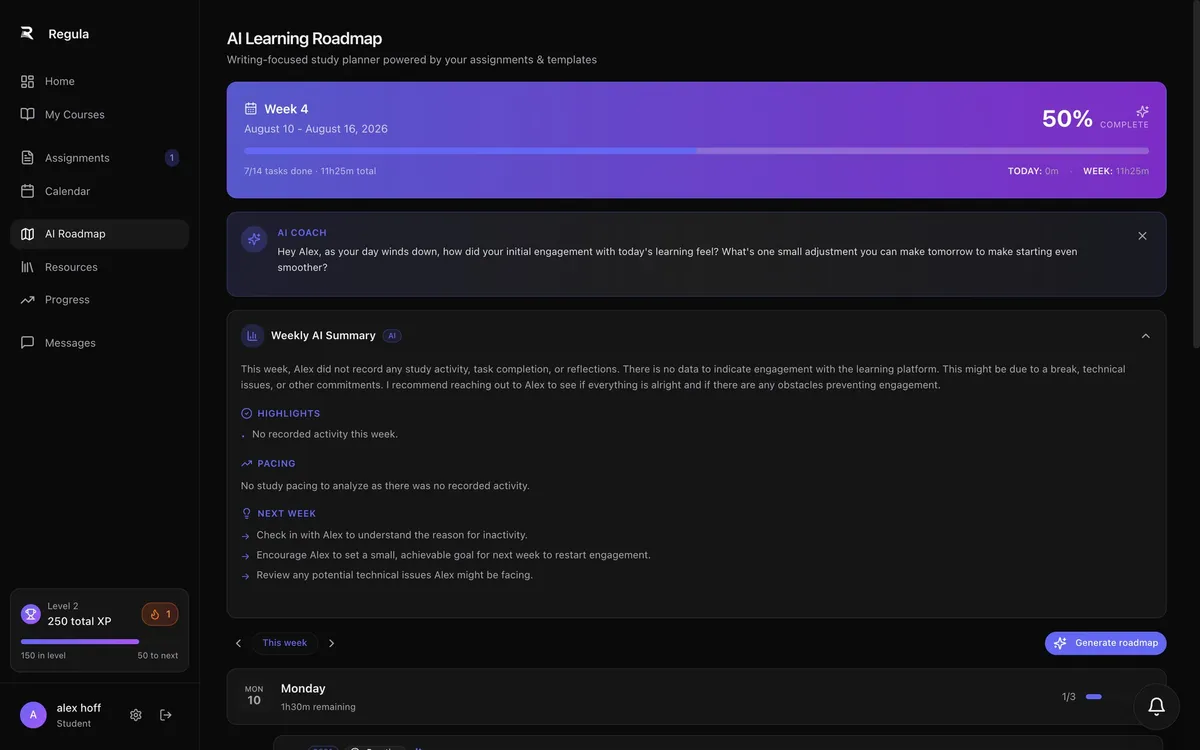
AI-enhanced
All three AI features are there.
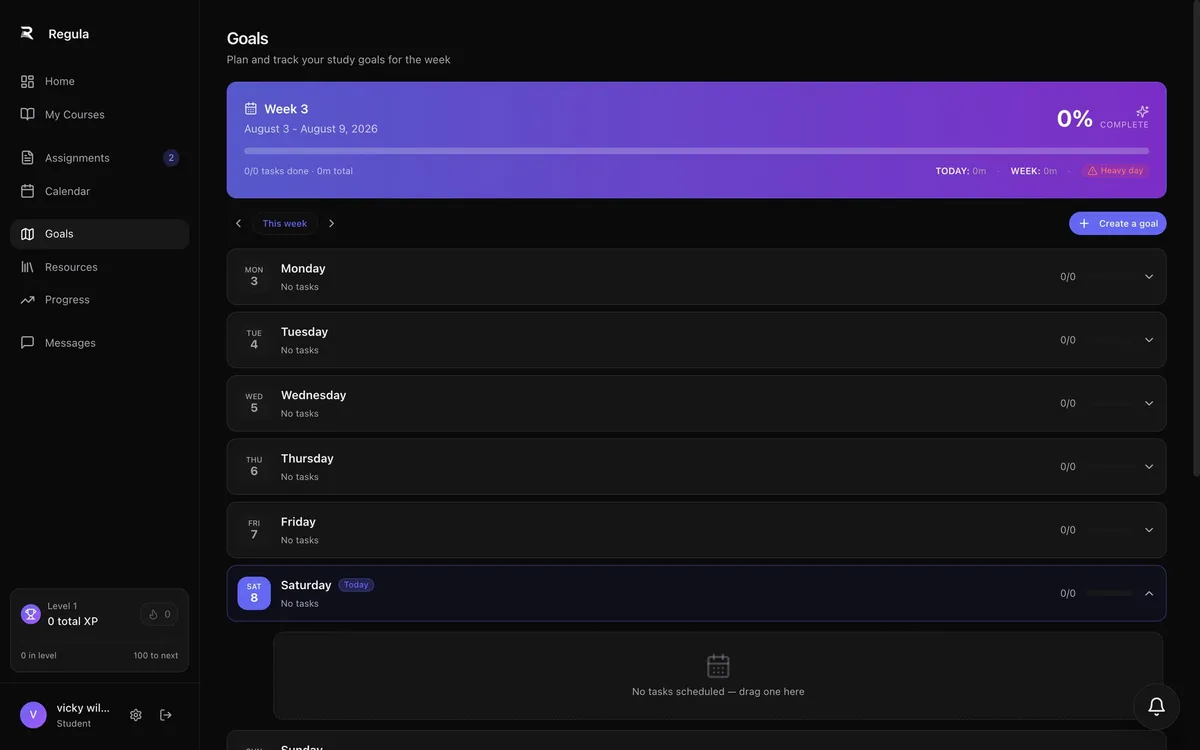
Controlled
Goals planned by hand, with no AI panel.
Test and iterate
Early test at LUT
46 students used an early version at the S.T.A.R.S. hackathon at LUT University in Finland. It scored 66 on the System Usability Scale, just under the commonly cited average of 68. Back then the gamification was badges, XP and levels. The leaderboard and streaks came from what those students told us.
A bug that turned out to be hierarchy
Several participants reported the reflection prompt firing three or four times at once, or not appearing at all. We went looking for the bug and there wasn’t one. Today looked like every other day of the week, so people were reading a different day than they thought. In the interviews, 9 of 10 AI-enhanced and 7 of 10 Controlled participants had trouble finding the prompts.
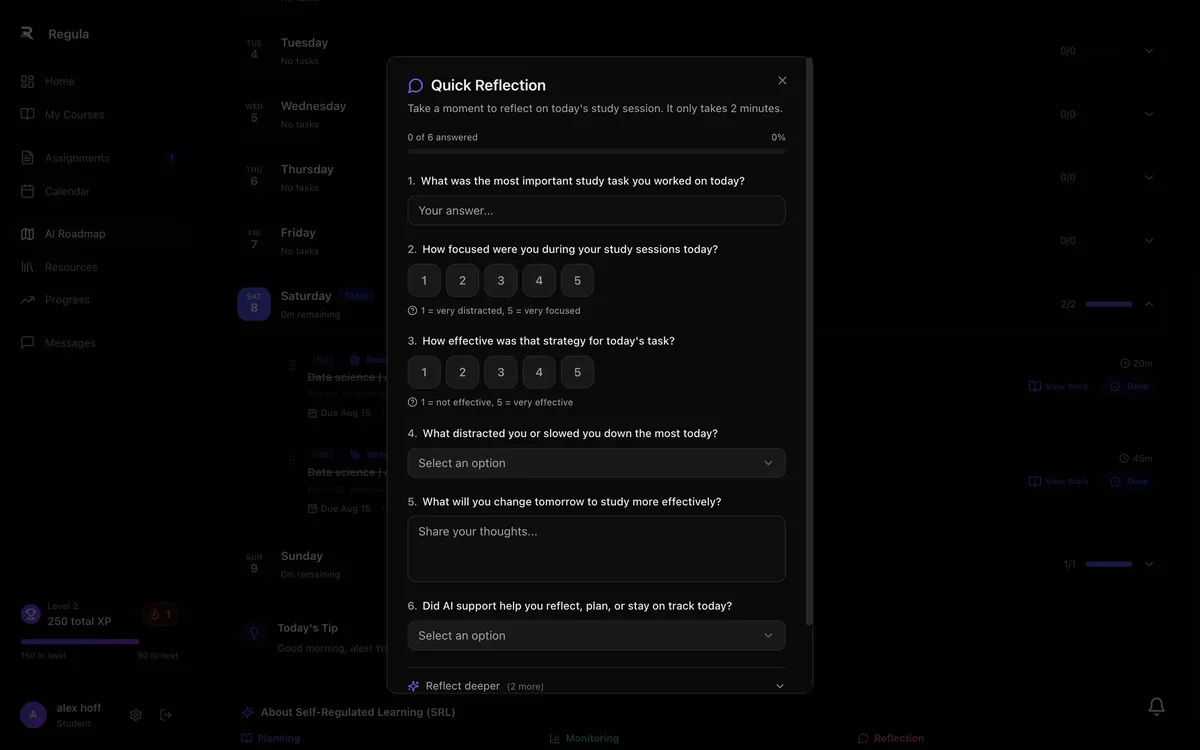
The daily prompt: six questions, about two minutes, once a day.
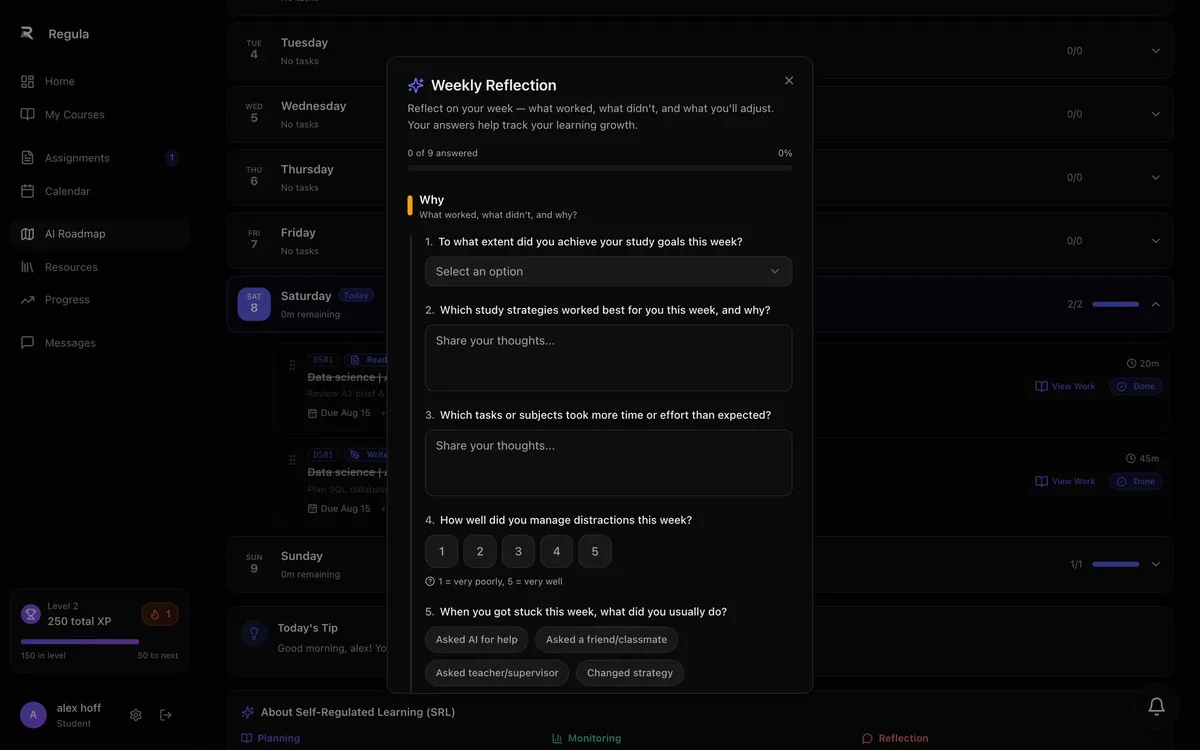
The weekly prompt on the same week view. No day stands out, so today is found by reading the date.
An onboarding video wasn’t enough
Some participants opened the app and didn’t know what to do, even after an onboarding video. A few skipped planning entirely, which I only found out by messaging them afterwards. Across both waves, 13 of the 54 students who enrolled never became active, and that didn’t differ between the two versions.
The loudest feature wasn’t the one people talked about
We gave the streak the strongest treatment on screen, a full-screen animation with particles. In the first wave’s interviews it barely came up, and people talked about the leaderboard instead, a plain ranked list with no motion at all. Across all 20 interviews, half the AI-enhanced participants and 8 of 10 Controlled said they ignored the gamification.
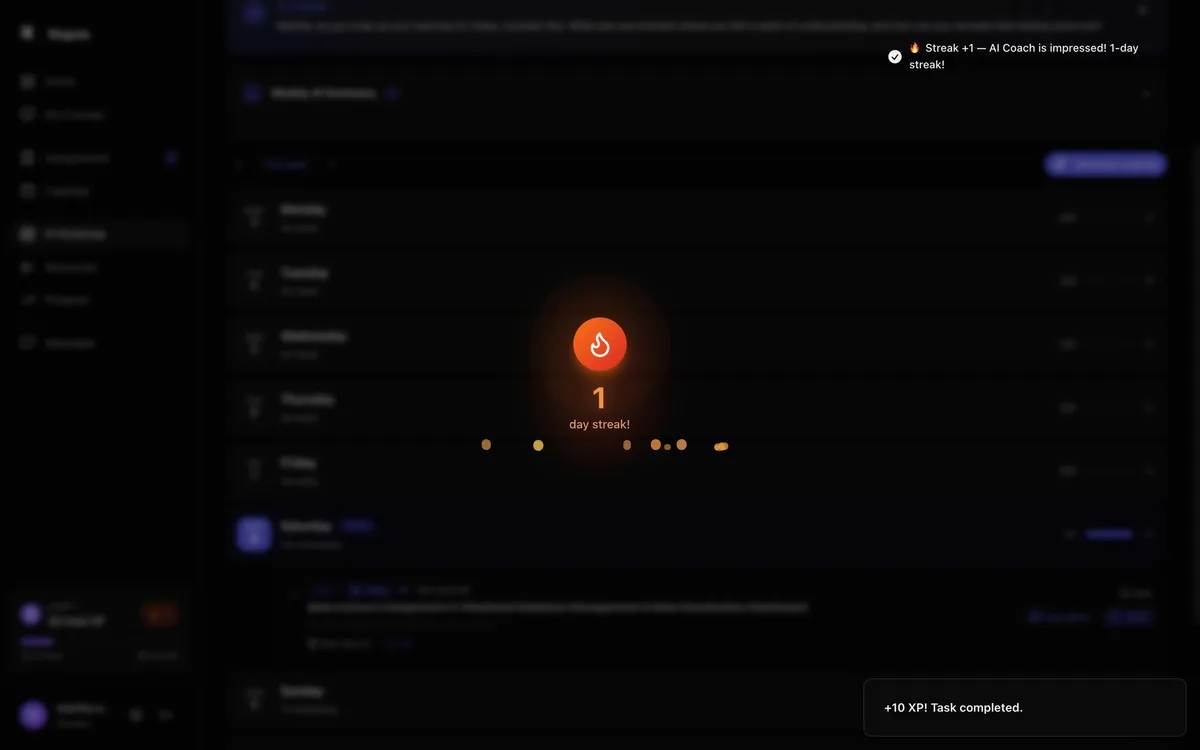
What we built loud.
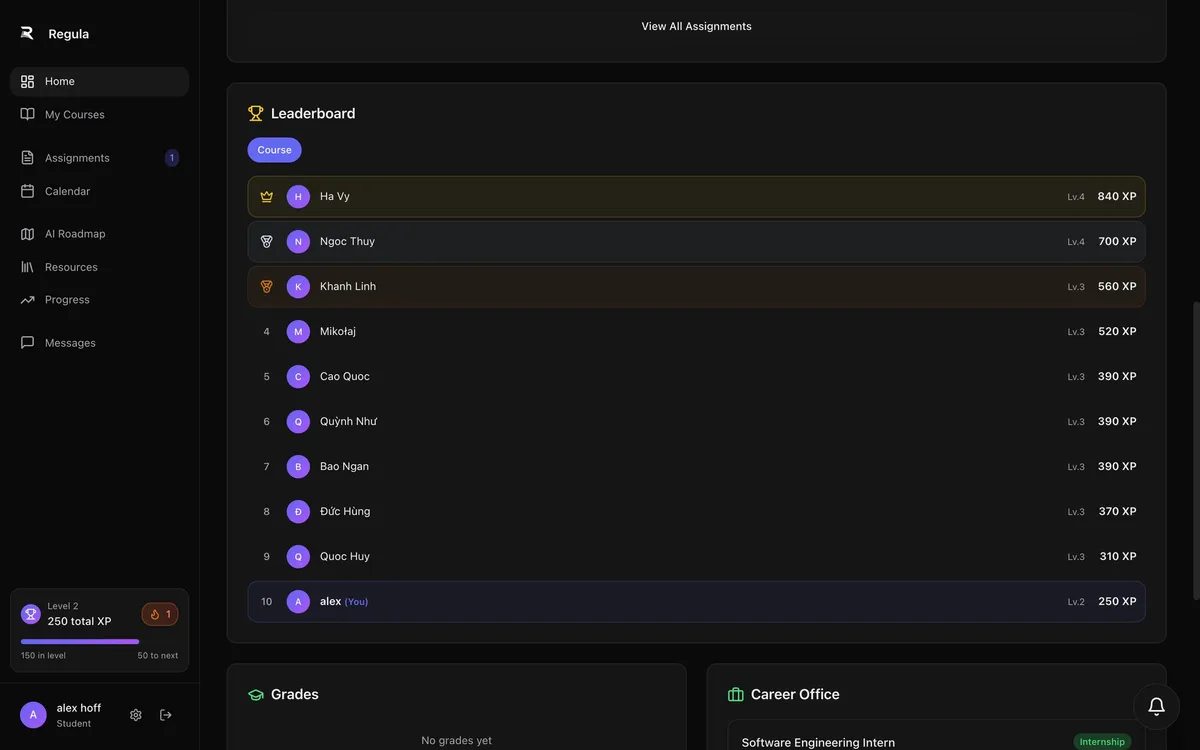
What people talked about.
A finding of ours that didn’t hold
The first wave suggested that AI-enhanced participants rated their own self-regulation higher than their logs showed, and the thesis reported it. With 33 questionnaire responses instead of 10, the difference disappeared: the two groups scored almost the same on all three subscales. I stopped using that claim and rebuilt the argument around what did hold.
Outcome
Behaviour moved. The questionnaires didn’t see it.
System logs
3.3×
as many tasks created by AI-enhanced participants. Mean 17.2 against 5.2.
p < .001, r = −.81
Interviews
10 of 10
AI-enhanced interviewees described changing how they studied after reflecting, against 7 of 10 Controlled.
Questionnaires
4.58 vs 4.49
Metacognitive self-regulation on the MSLQ, AI-enhanced against Controlled. Both MAI subscales were close too.
Planning moved. Finishing didn’t.
- AI-enhanced
- Controlled
Tasks created
p < .001, r = −.81
Active planning days
p = .045, r = −.41
Longest streak, in days
p = .009, r = −.53
Completion rate
p = .284, not significant
| Measure | AI-enhanced, mean (median) | Controlled, mean (median) | U | p | r |
|---|---|---|---|---|---|
| Tasks created | 17.2 (15) | 5.2 (3) | 240.5 | < .001 | −.81 |
| Active planning days | 6.7 (4) | 4.4 (3) | 188.0 | .045 | −.41 |
| Longest streak, in days | 3.4 (3) | 2.2 (1.5) | 204.0 | .009 | −.53 |
| Completion rate | 81% (88%) | 70% (70%) | 162.0 | .284 | −.22 |
The median AI-enhanced participant did nothing at all in week one.
Everyone had access for all fourteen days. Most activity in both groups came in week two, and AI support didn’t pull it any earlier: tasks created in the AI-enhanced group went from a mean of 4.4 in week one to 8.7 in week two. Planning got easier without starting any earlier, and the paper’s title, Scaffolding without Execution, comes from that gap.
The part we left empty
Regula supported planning at one end of the cycle and reflection at the other. Keeping track, in the middle, had nothing that signalled progress. Both groups felt it: 9 of 10 AI-enhanced and 7 of 10 Controlled interviewees described the gap, and most kept track by hand instead.
What 20 interviews said
- AI-enhanced
- Controlled
- Planning felt like less effort
- A short-term boost in engagement
- Changed how they studied after reflecting
- Had trouble finding the prompts
- Felt a gap in keeping track of progress
- Kept track by hand
- Ignored the gamification
- Missed having notifications
- Used AI tools outside Regula
| Code | AI-enhanced | Controlled |
|---|---|---|
| Planning felt like less effort | 100% (10 of 10) | 30% (3 of 10) |
| A short-term boost in engagement | 70% (7 of 10) | 10% (1 of 10) |
| Changed how they studied after reflecting | 100% (10 of 10) | 70% (7 of 10) |
| Had trouble finding the prompts | 90% (9 of 10) | 70% (7 of 10) |
| Felt a gap in keeping track of progress | 90% (9 of 10) | 70% (7 of 10) |
| Kept track by hand | 80% (8 of 10) | 60% (6 of 10) |
| Ignored the gamification | 50% (5 of 10) | 80% (8 of 10) |
| Missed having notifications | 40% (4 of 10) | 80% (8 of 10) |
| Used AI tools outside Regula | 10% (1 of 10) | 50% (5 of 10) |
Trust followed the feature rather than “AI” as a whole. 7 of 10 AI-enhanced interviewees trusted the Roadmap, and 9 of 10 described their trust in the AI as conditional.
Half the Controlled interviewees used AI tools outside Regula anyway, so a condition without AI in the product still has AI around it.
What I’d change
Give keeping track a signal.
Something between planning and reflecting that shows progress, since both groups were doing it by hand.
Make today unmissable.
And put the prompts where people already look.
Add notifications.
8 of 10 Controlled and 4 of 10 AI-enhanced interviewees named their absence.
Nudge from behaviour.
What someone did yesterday should decide what the app asks today, instead of a fixed schedule.
Where it is now
The paper, Scaffolding without Execution, is in preparation for PERSUASIVE 2027. The master’s thesis was graded 4 of 5 and is published in DiVA. The study version, built on Lovable, is still live and collecting data. Regula is now being developed as a product: Nikodem leads it, and I work on UX research and product.